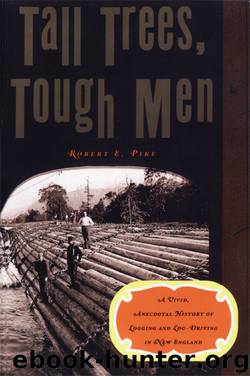
Tall Trees, Tough Men by Robert E. Pike
Author:Robert E. Pike [Pike, Robert E.]
Language: eng
Format: epub
Publisher: W. W. Norton & Company
Published: 0101-01-01T00:00:00+00:00
15
Logging Railroads
THE late years of the nineteenth century and the early years of the twentieth formed an era of expansion. New England was emerging from the period following the Civil War. Cities were being built, all of wood. Lumber was king. Trees had to be cut down and marketed. If they couldn’t be profitably floated down rivers, then they had to come out some other way.
The logging railroad was the answer. In those early days the virgin forest came right down to the village limits, so the railroads were built out into the timber a little way and were gradually extended as the woods were cut back. They were all standard gauge—4 feet 8½ inches—and the lumber companies were helped very much by competing railroad companies: the Boston and Maine, the Maine Central, and the Grand Trunk expected to make money on freight receipts for hauling the lumber, so they cheerfully rented rails, switches, and other expensive track properties to the logging firms. Frequently other items of equipment, large and small, were thrown in gratis.
What is now known as standard gauge was by no means universally used on the early American railroads. This gauge of track came to us from England, and its origin is interesting. The distance between the wheels of the ancient Roman chariots happened to be 4 feet 8½ inches; English carts and wagons followed suit, and when the first railroad track in that country was laid, the “gauge” of the familiar horse-drawn vehicles was used for the new “highway.”
For the first twenty years all the locomotives were wood-burners. If a crew ran short of fuel all they had to do was to stop and cut down a few trees and away they would go, shooting sparks in every direction and causing numerous forest fires, some of them very disastrous indeed. Later, coal was used, and fires decreased somewhat.
Most logging railroads operated only during the winter, when the ground was frozen hard, but others worked all the year round, and picked up small change in the summer by putting benches or chairs on the cars and running “excursions” into the wilds for tourists. In those days, summer visitors came by train or stage-coach and would spend the whole summer at one hotel, instead of staying only a short time as is the custom today. It was no trick to sign up a hundred or more young gentlemen and ladies on a fine Saturday afternoon, at North Woodstock, or Conway, New Hampshire, to take a bumpy but jolly ten-mile ride through magnificent scenery to some large logging camp where everyone was served pies, cakes, doughnuts, and tea cooked by doughty woods chefs.
Vermont never had more than half a dozen logging railroads. The Rich Lumber Company built the Lye Brook Hollow branch in Manchester, and in 1885 the Deerfield Valley Company built eleven miles of railway to reach its wood-pulp and sawmill plants at Readsboro. In 1892 this road was extended as far as Wilmington. There were one or two other short lines, but they were not primarily built to haul logs.
Download
This site does not store any files on its server. We only index and link to content provided by other sites. Please contact the content providers to delete copyright contents if any and email us, we'll remove relevant links or contents immediately.
| Africa | Americas |
| Arctic & Antarctica | Asia |
| Australia & Oceania | Europe |
| Middle East | Russia |
| United States | World |
| Ancient Civilizations | Military |
| Historical Study & Educational Resources |
Cat's cradle by Kurt Vonnegut(15380)
Pimp by Iceberg Slim(14540)
4 3 2 1: A Novel by Paul Auster(12420)
Underground: A Human History of the Worlds Beneath Our Feet by Will Hunt(12106)
The Radium Girls by Kate Moore(12045)
Wiseguy by Nicholas Pileggi(5801)
The Fire Next Time by James Baldwin(5458)
Perfect Rhythm by Jae(5420)
American History Stories, Volume III (Yesterday's Classics) by Pratt Mara L(5316)
Paper Towns by Green John(5202)
Pale Blue Dot by Carl Sagan(5021)
A Higher Loyalty: Truth, Lies, and Leadership by James Comey(4974)
The Mayflower and the Pilgrims' New World by Nathaniel Philbrick(4511)
The Doomsday Machine by Daniel Ellsberg(4499)
Killers of the Flower Moon: The Osage Murders and the Birth of the FBI by David Grann(4454)
The Sympathizer by Viet Thanh Nguyen(4405)
Too Much and Not the Mood by Durga Chew-Bose(4359)
The Borden Murders by Sarah Miller(4337)
Sticky Fingers by Joe Hagan(4211)
